Climate Security Down Under
Australia's First National Climate Risk Assessment

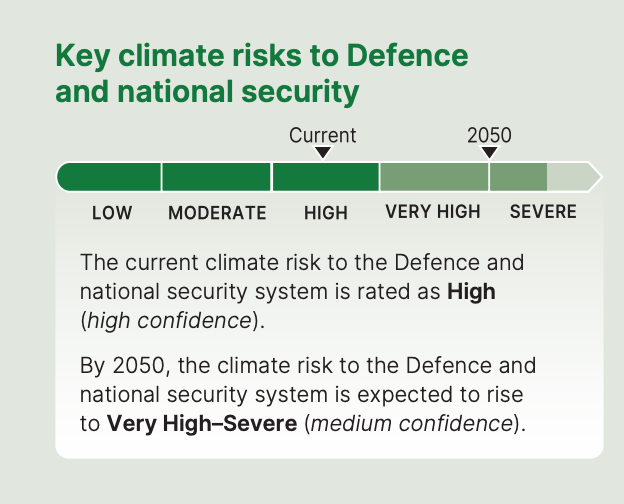
Today, Australia released its first-ever National Climate Risk Assessment, a comprehensive look at how climate change will affect the country’s people, places, and ways of life. There’s a lot to dig into (the summary overview is a whopping 72 pages alone!), but of course I immediately scrolled to the defense and national security section — and was duly impressed.
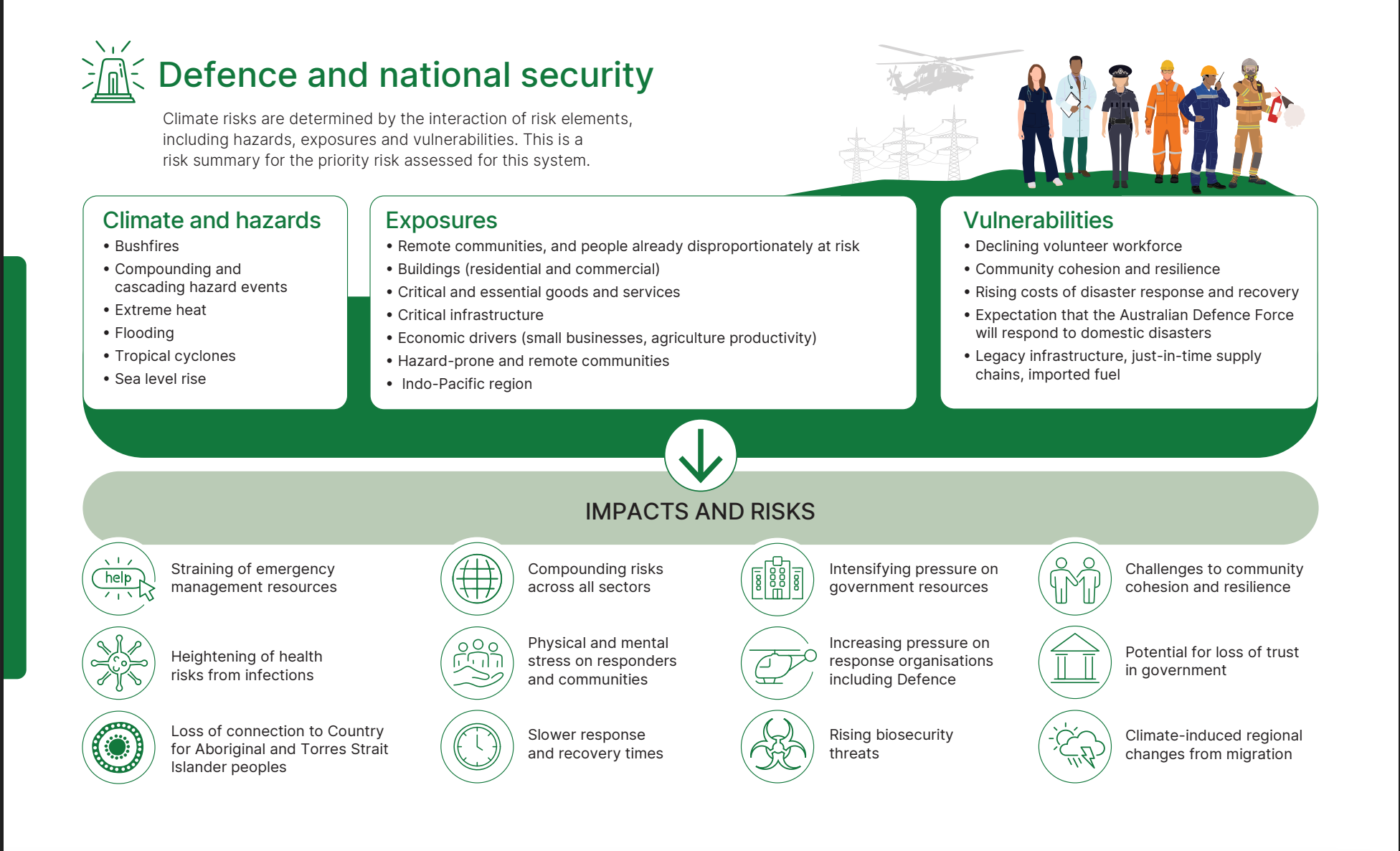
The report takes a remarkably expansive view of security, and identifies four key climate risks to defense and national security:
Compounding and cascading events: climate risks will “cascade across various sectors such as agriculture, transport, supply chains, human health, and energy and water security. This interconnectedness amplifies the challenges for Australia’s national security and emergency management response, stretching the system’s resources and funding to their limits.”
Communities at risk: the report notes that, “Australia’s Aboriginal and Torres Strait Islander peoples, face heightened risks from disrupted critical infrastructure, climate-sensitive infections and communicable diseases. Biosecurity risks are also on the rise, further complicating the emergency management landscape.”
Emergency management resources: “The additional pressure from increased extreme weather events is challenging the physical and mental health of emergency management personnel and volunteers, who are increasingly exposed to extreme heat and impacts from other hazards…adding psychological and physical stress that hampers their effectiveness.”
Defence: “The public may perceive reliance on the Australian Defence Force for disaster response as stretching them beyond their mission. Conversely, seeking to reduce reliance on Australian Defence Force may raise concerns if alternatives are not readily available…The concurrent risks associated with the geostrategic environment and acceleration of major climate events risks overwhelming the Australian Government’s capacity to respond effectively and detract from Defence’s primary objective of defending Australia.”
This last point regarding the strain on Australia’s military is not new, as I wrote in Climate Change on the Battlefield:
Australia’s 2023 Defense Strategic Review identified climate change as a national security issue and stated, “The acceleration of major climate events risks overwhelming the Government's capacity to respond effectively and detracting from Defence's primary objective of defending Australia. Climate events already place concurrency pressures on the Australian Defence Force (ADF) and this has negatively affected force preparedness, readiness and combat effectiveness." Some in parliament have also argued the pace of ADF domestic deployment is unsustainable. Federal Labor MP Julian Hill said, “[The military] can't be seen by the states and territories or the Australian community as some kind of shadow workforce. We're risking degrading the war-fighting capability of the Australian Defence Force.”
What’s impressive, however, about the risk assessment’s analysis is its recognition of the inherent tensions and trade-offs in the discussion about the use of the defense forces. It explicitly notes the need for a “careful balance” between overstretching the defense forces and pulling them away from domestic response without an alternative in place. This is precisely the conversation countries should be having, as I wrote about last month on warring with wildfires (see below).
We're "At War" With Wildfires

“It is warfare. You have an adversary that you detect and that is moving, and you have to figure out how to engage that adversary.”
All in all, the Australian government deserves kudos for this excellent approach to climate change and national security. Of course, as we’ve found in the United States, the analysis of the climate security problem is much easier than taking action to address it — but this report provides a strong foundation on which to start.
PS-For more on climate security in Australia, check out the Australian Security Leaders Climate Group and this interview with one of their executive members, Cheryl Durant. The Australian Strategic Policy Institute also does excellent work on climate security.